
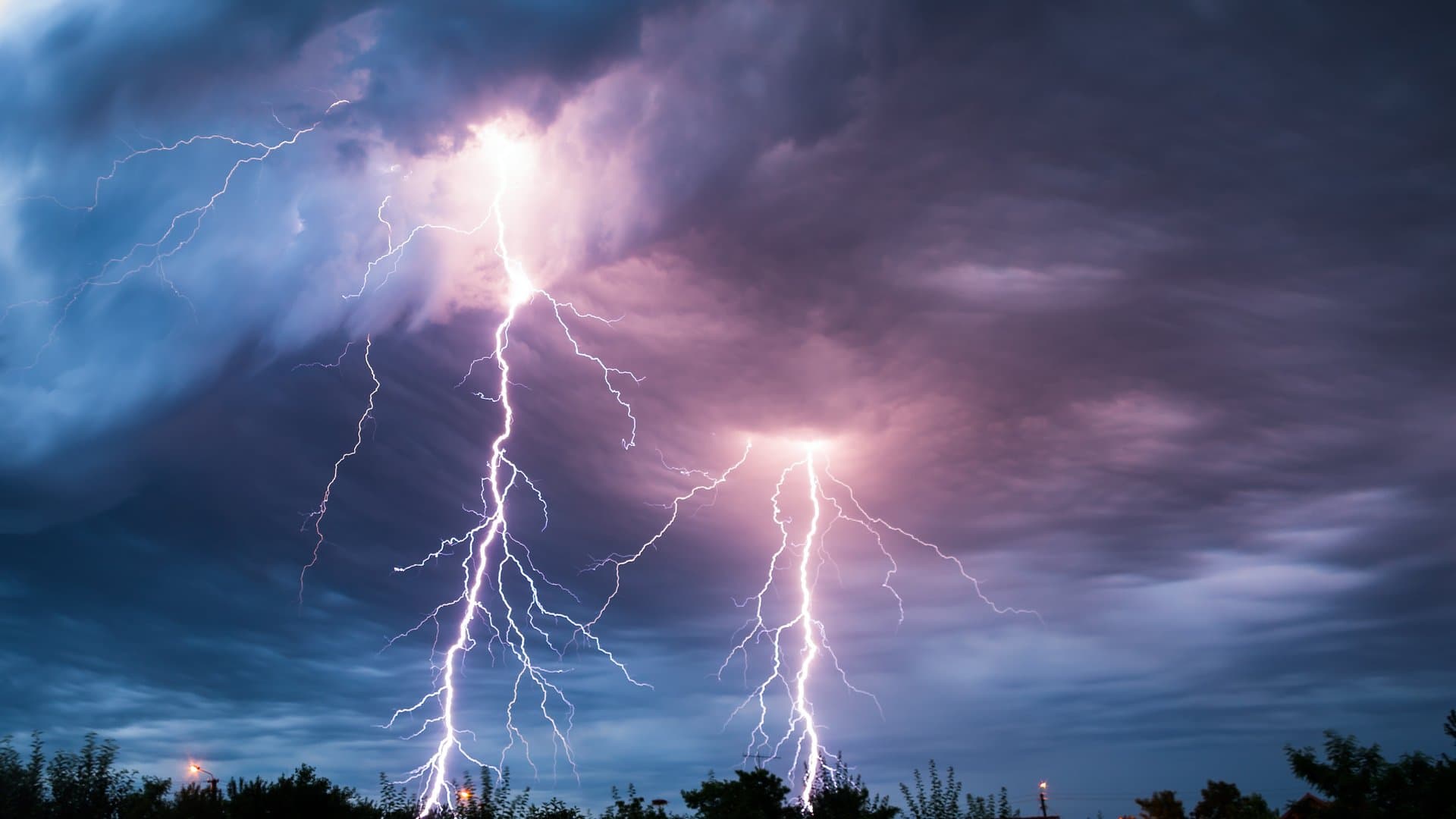
After the hot summer days, powerful thunderstorms are moving into many parts of Germany this week. In addition to heavy rain, hail, and strong gusts of wind, there is also a risk of lightning. Anyone who behaves correctly during a thunderstorm can significantly reduce the risk of a lightning accident.
Every year in Germany, according to various estimates, up to 200 people are struck by lightning. The VDE reports accidents with approximately 110 people injured annually. According to this, about four people die each year as a result of a lightning strike - significantly fewer than a few decades ago. This is likely due in part to the fact that more people today know how to protect themselves during thunderstorms.
When does a thunderstorm become dangerous?
If thunder rumbling can be heard, the thunderstorm is according to VDE less than ten kilometers away. If ten seconds or less pass between lightning and thunder, there is an acute risk of lightning - a strike can occur at any time. Only when no thunder has been heard for at least 30 minutes is the danger considered to have passed.
Protecting yourself from thunderstorms outdoors
Anyone outdoors should seek shelter in a solid building or a closed car as quickly as possible when a thunderstorm approaches. The metal body of a car acts like a Faraday cage and conducts the lightning current around the occupants on the outside.
If no safe shelter is reachable, you should make yourself as small as possible and not be the highest point in the area. The so-called lightning protection crouch is recommended: squat down, place your feet close together, and tuck in your head. On the other hand, you should not lie flat on the ground, as this increases the risk of so-called step voltage.
Additionally, sufficient distance should be kept from isolated trees, metal fences, poles, bicycles, and bodies of water. Groups should also spread out and maintain a few meters of distance from each other so that in an emergency, multiple people are not injured simultaneously.
What happens during a lightning strike?
When lightning strikes a person, voltages of several hundred thousand volts take effect within fractions of a second. Although most of the current flows off via the body surface, severe burns can still occur. The effects on the heart and nervous system are particularly dangerous: the heartbeat can stop, as can breathing.
In addition to life-threatening injuries, symptoms such as tingling in the arms and legs, dizziness, nausea, as well as visual, hearing, or olfactory disturbances frequently occur. Memory problems and chronic pain can also be long-term consequences of a lightning strike.
First aid for a lightning strike
If a person is struck by lightning nearby, it is important to act immediately. Quick first aid can save lives: In the event of cardiac arrest, the lack of oxygen supply leads to permanent brain damage after three to four minutes. Good to know: A second lightning strike immediately after the first in the same location is considered unlikely, but is not impossible. Injured persons should be brought to a safe location as quickly as possible. It is safe to touch the injured person.
First, you should check the person's consciousness and in any case call emergency services at 112. If the person responds, you can provide assistance as needed and wait together for emergency services.
If the person does not respond, they should first be turned onto their back. Then it is important to clear the airways: To do this, slightly tilt the head back and lift the chin, then check breathing by looking, listening, and feeling. If the person is breathing normally, they should be placed in the recovery position and breathing should continue to be monitored until emergency services arrive.
If the person has no normal breathing (respiratory arrest or gasping), chest compressions and rescue breathing should be performed in constant alternation until professional help arrives: press 30 times and give two rescue breaths.