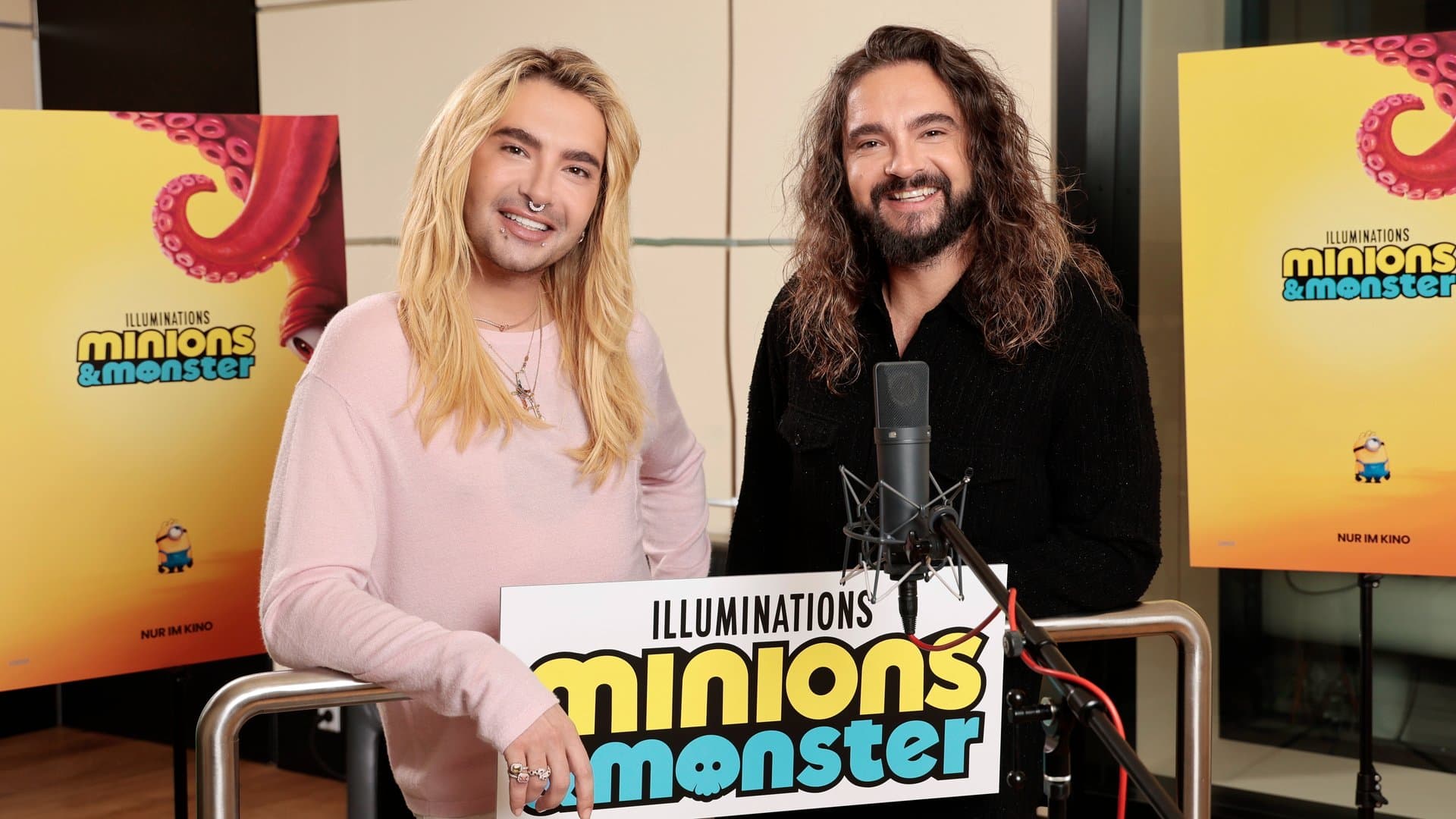
In the German version of the new animated film "Minions & Monster" (cinema release: July 1), twins Bill and Tom Kaulitz (36) are on board as voice actors. Tom voices Dort, an alien robot and conqueror who wants to seize control of Earth with his army. Part of the Minions initially serve him as loyal followers and support his plans. In the original version, the character is voiced by Jesse Eisenberg (42).
Meanwhile, the Minions around James and Henry, together with the little green monster Goomi, want to make a Hollywood monster movie in the 1920s. Bill Kaulitz voices the villain Goomi - in the US version, Emmy, Grammy, and Tony Award winner ("South Park", "The Book of Mormon") Trey Parker (56) has taken on the part.
Distorted Voices
Hollywood legend Christoph Waltz (69) is also part of the cast; he voices the opportunistic director Max in both the original and the German version - you can clearly hear him. Things are somewhat different with the Kaulitz twins: If you don't know who's voicing whom, you can barely recognize their quite distorted voices. Perhaps a small disappointment for fans of the two Tokio Hotel musicians, but it doesn't detract from the general Minions fun.
While the prominent voice actors lend their voices to the new characters, one thing remains unchanged: The Minions themselves also speak in this third part of the "Minions" film series, a prequel series to the film series "Ich - Einfach unverbesserlich" (since 2010), their unmistakable fantasy language that has delighted millions of viewers for years. Behind terms like "Bello", "Banana", or "Poopaye" there is far more than mere nonsense.
The Language of the Minions
Those who have seen the "Minions" films usually remember not only the yellow characters themselves, but also their unusual language. This artificial language was specially developed for the now two film series by filmmakers Pierre Coffin and Chris Renaud. According to "RadioTimes", Coffin played a central role: Over the years, he personally recorded the voices of hundreds of Minions himself.
As "Motion Pictures" reports, the so-called "Minionese" emerged from a mix of various real languages. Coffin drew on words and expressions from English, French, Spanish, Italian, and other languages. Added to this are fantasy words, onomatopoetic elements, and spontaneous ideas. There is no fixed dictionary or comprehensive set of rules. Rather, the language was designed so that it can be understood regardless of the respective national language.
Recurring "Minionese" Terms
However, some terms have recurring meanings, as "Allociné" summarizes. For example, the Minions frequently use "Bello" as a greeting. "Poopaye" is often used as a farewell. The word "Banana" appears regularly and refers to the characters' well-known preference for bananas. Many other expressions arise situationally and primarily serve to convey emotions and moods.
Linguistically, "Minionese" can be classified as a so-called fictional or artificial language. Unlike fully developed artificial languages such as "Klingonisch" from the science fiction universe of "Star Trek" or "Elbisch" invented by British linguist and author J. R. R. Tolkien for his fictional world Middle-earth ("Herr der Ringe"), "Minionese" does not possess an elaborate grammar or extensive vocabulary. Its purpose lies less in realistic communication than in the humorous support of the plot.
Characters Understandable Across Cultures
Nevertheless, the international success of the Minions is also connected to this linguistic concept. Since the characters don't speak a national language, viewers in different countries can perceive their statements similarly. The language barrier is reduced, while gestures, facial expressions, and situational comedy move more to the forefront. This facilitates the worldwide marketing of the films and makes the characters understandable across cultures.
Particularly remarkable is that the Minions are intuitively understood by many viewers despite their seemingly incomprehensible language. Responsible for this are the intonation, body language, and context of the respective scene. The language thus functions less through concrete meanings than through emotional signals.
With films like "Minions" and "Minions: Auf der Suche nach dem Mini-Boss", "Minionese" has become a fixed component of pop culture.