
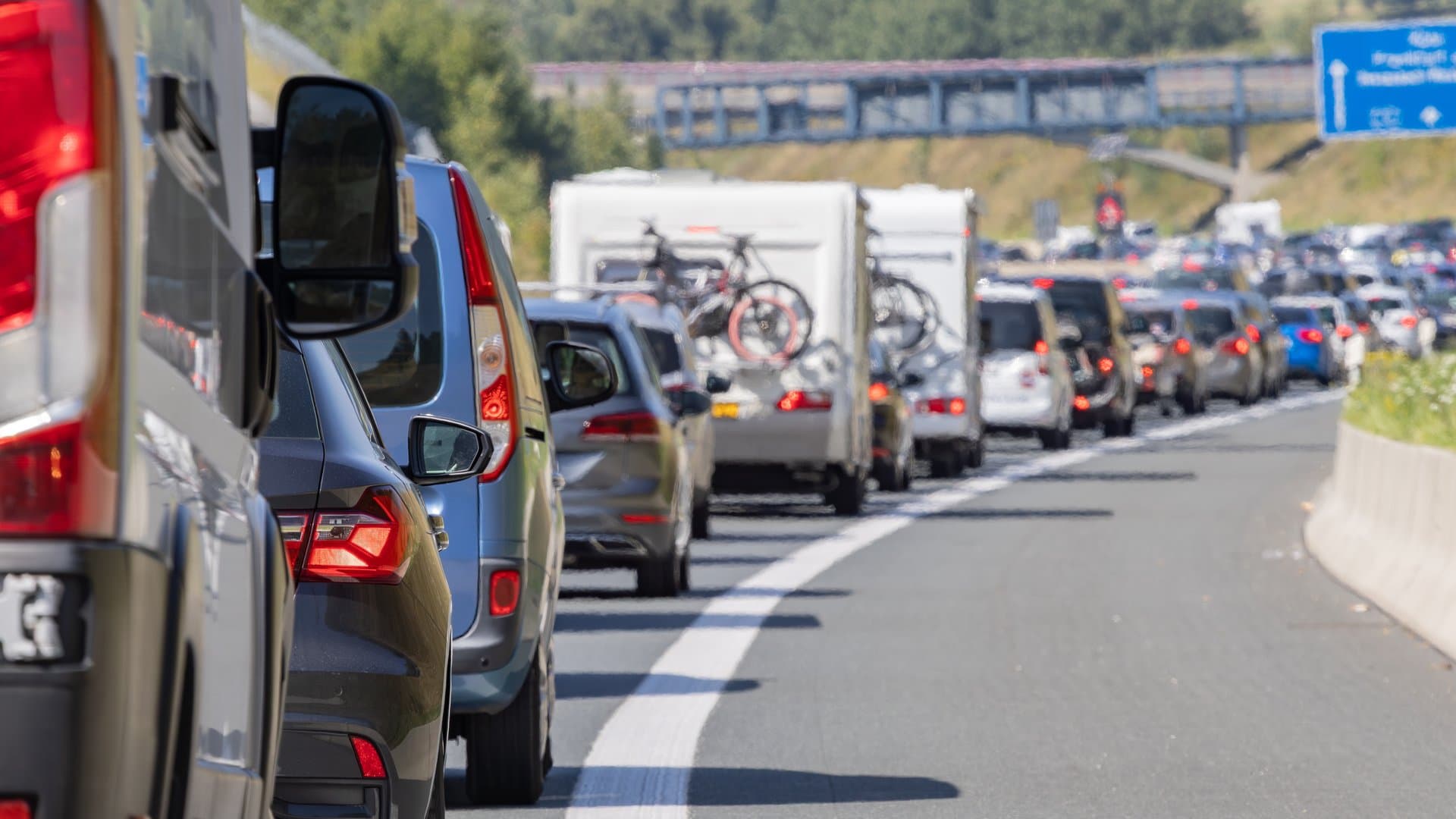
On July 20, summer vacation begins in North Rhine-Westphalia, Germany's most populous state with around 18 million residents. On the weekend immediately preceding it, from July 17 to 19, travel traffic reaches its next peak.
Because school is now only still in session in Bavaria and Baden-Württemberg, millions of people are traveling simultaneously nationwide. The rush is intensified by vacationers from neighboring countries, where holidays are also taking place and who traverse Germany on their way south or to the coasts. Anyone planning a longer trip should calculate significantly more time than usual.
Friday afternoon and Saturday morning most critical
The ADAC expects the highest risk of traffic jams on Friday afternoon, when commuters and vacationers crowd onto the same routes, as well as on Saturday morning on the classic long-distance routes. On Saturday and Sunday evening, return traffic is added, so that the congestion continues throughout the entire weekend. In summer weather, traffic increases additionally because then countless day-trippers also drive toward the Alps, low mountain ranges, lakes, and coasts.
Around 1,000 construction sites and congested metropolitan areas
Nationwide, approximately 1,000 construction sites additionally slow down traffic flow. Particularly vulnerable are the north-south routes A1, A3, A5, A7, and A8, the east-west connection A2, as well as the approach routes to the Alps such as A8, A93, A95, and A96. Around several major events, additional crowds and limited parking space are expected: In addition to the "Largest Fair on the Rhine" in Düsseldorf and the Deichbrand Festival near Cuxhaven, the Parookaville Festival at Weeze Airport on the German-Dutch border and the Formula 1 Grand Prix in Spa-Francorchamps, Belgium - both from July 17 to 19 - attract tens of thousands of visitors.
Austria: Narrow transit routes and exit closures in Tyrol
Beyond the border, the situation also remains tense. In Austria, holiday traffic and numerous construction sites cause delays on the most important north-south connections, primarily on the West, Tauern, Inntal, Brenner, Phyrn, and Rheintal motorways. On the Brenner motorway, renovation work on the Lueg Bridge continues to have an impact; traffic is also expected to be congested on the Fernpass route (B179) and the Arlberg road.
In Tyrol, numerous alternative routes for through traffic remain closed on weekends to relieve towns from cut-through traffic. On Monday, July 20, block clearance for trucks at the Kufstein border crossing will also resume. The ÖAMTC also points out in a press release bottlenecks at toll stations and tunnels, such as on the Karawanken motorway (A11) and on the Phyrn motorway (A9).
Switzerland and Italy: Gotthard and Brenner as bottlenecks
In Switzerland, travel traffic concentrates on the classic transit routes: the Gotthard route (A2), the San Bernardino route (A13), as well as motorways A1 and A3. In Italy, the Brenner motorway (A22) toward Lake Garda and the Adriatic is considered particularly critical, as is the connection from the Swiss border via Milan to Genoa.
Plan for border controls
When returning to Germany, drivers should factor in additional waiting times at the borders. Due to ongoing controls - internal border controls have been extended until mid-September 2026 - delays can occur particularly at crossings from Austria, Poland, the Czech Republic, and Switzerland. At least Slovenia lifted its temporary border controls to Croatia and Hungary in mid-June.
Anyone who is flexible should preferably avoid peak hours by traveling during off-peak times or on weekdays during the week.