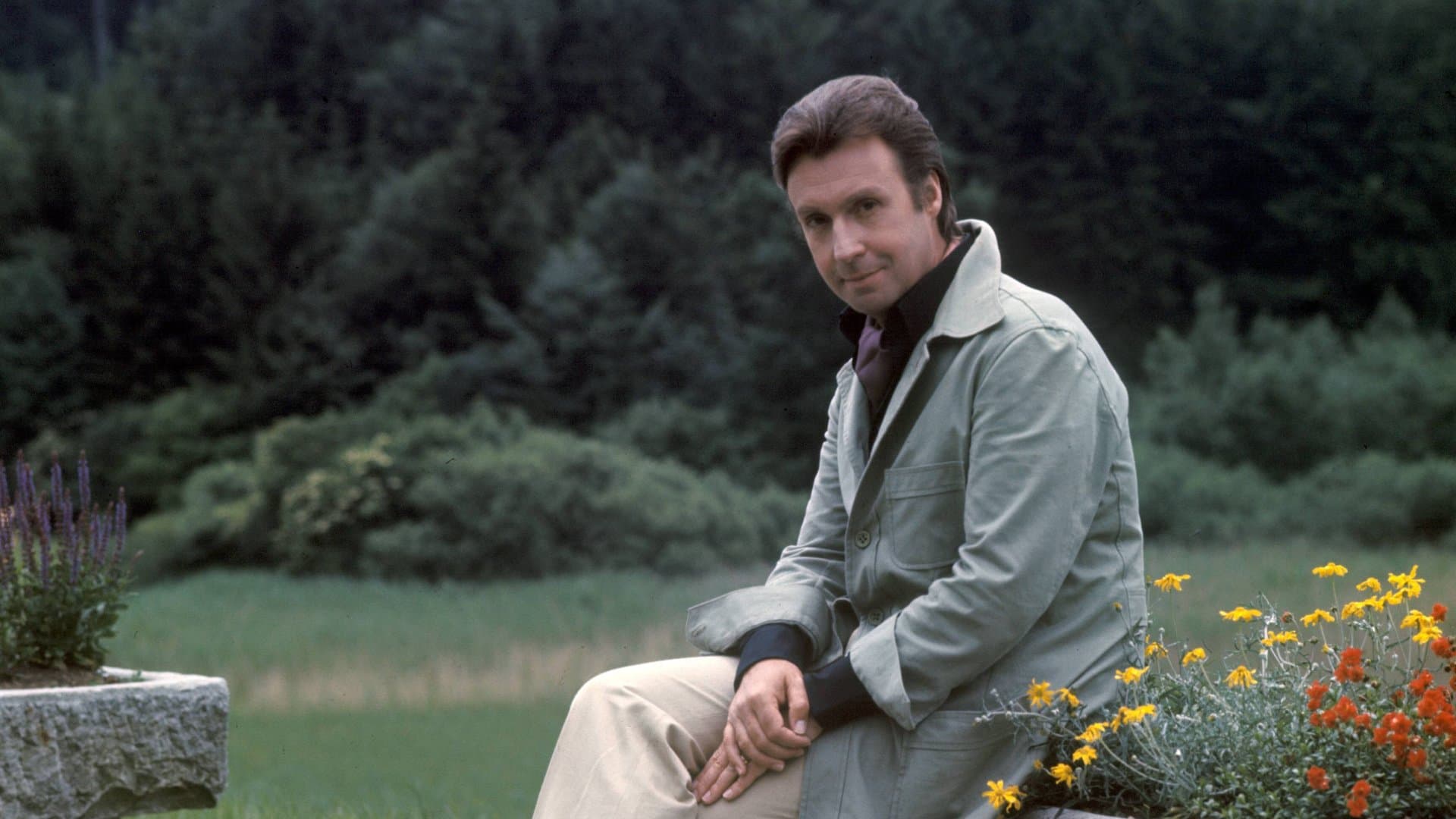
He had an ageless face: Funny brown eyes that could look not only mischievous, but also guilty, dreamy or melancholy. Even at over 80, when only sorrow remained from life, one saw a remarkably youthful-looking, even timeless Peter Alexander, with graying hair, wrinkles around his eyes and a wistful smile, yet it was the pain and wistfulness of an abandoned boy that had marked his face.
This image lingers, but many other images showing a radiant, eternally cheerful Peter Alexander are far more well-known. Peter the Great, they called him. He was the patron saint of German-language entertainment culture, a monument to light entertainment, even today, 15 years after his death. The reason he's being talked about more these days is due to a round anniversary of this legend: On June 30, Peter Alexander would have celebrated his 100th birthday.
Germany's Favorite Entertainer
The singer, actor and TV show star Peter Alexander, whose full name was Peter Alexander Ferdinand Maximilian Neumayer, was considered one of the most beloved entertainers in the German-speaking world during his 60-year, completely scandal-free career. He appeared in around 40 feature films, hosted major Saturday evening shows with up to 38 million viewers in Germany alone, and was the only German-language singer to appear in the German hit charts for six decades with his pop songs. A success that remains unmatched to this day.
Peter Alexander could also have made his way internationally, if only he had wanted to. Caterina Valente (1931-2024) was once convinced of this. The singer knew what she was talking about: She herself was an internationally celebrated artist and also successful in the USA.
How Peter Alexander Found His Way
The entertainer embodied the proverbial charm of his hometown Vienna, though without the sharpness that often lurks behind it. Yet even without it, he was quite a handful. The family-his father was a bank clerk, his mother a housewife-lived in Vienna's 9th district, Sechsschimmelgasse 4. From the apartment balcony, five-year-old Peter allegedly spit on passersby, for which he received slaps from his father.
He had to leave the humanistic gymnasium in the 18th district prematurely because of his pranks. His father sent his son to the particularly strict state grammar school in South Moravian Znaim (Znojmo), after all, he was supposed to study medicine, and for that you need a high school diploma, which Peter also achieved in 1944. He joined the navy, experienced the last months of the war in Denmark and East Frisia, was taken into English captivity, from which he returned to Vienna in May 1946.
Although he enrolled in medicine at the University of Vienna, he only attended one lecture, because he had other things in mind: He absolutely wanted to become an actor. He graduated with honors from the renowned Max Reinhardt Seminar in 1948, and from then on he was no longer called Neumayer, but adopted his two first names as Peter Alexander. He wanted to become a great actor, his goal: the Burgtheater. In 1950 he saw a performance by Frank Sinatra (1915-1998) in London, after which it was clear to him: Forget the Burgtheater, your future is entertainment.
His Great Love Hilde
He had his first beginnings at Vienna's operetta venue Bürgertheater, as he could also sing enchantingly. There he met the Viennese chanson singer Hilde Haagen, with whom he fell deeply in love. They first met in the anteroom of a radio producer. "What does one do in Vienna to earn such bling?" he allegedly asked, her resolute answer: "Certainly not with your warbling!" Four months later they were married.
Hilde gave up her own career and managed her husband, cleverly setting the course for his unique success. In 1953, the still barely known Peter Alexander won a singing competition at the German Theater in Munich. Now he was at least known in professional circles, and the first film offers came. In 1955 he had his first major success with the male lead role in the musical film "Liebe, Tanz und 1000 Schlager". He had already recorded his first record in 1951: "Das machen nur die Beine von Dolores".
Singer, Actor, Show Star: "Whatever Fits"
Was he a singing actor or a singer with acting ambitions? Peter Alexander saw it pragmatically, "whatever fits". Many of his pop songs like "Die süßesten Früchte", "Der letzte Walzer", "Hier ist ein Mensch", "Ich zähle täglich meine Sorgen" or "Die kleine Kneipe" became earworms that every child knew.
His comedies like "Die Abenteuer des Grafen Bobby" or "Charley's Tante" and operetta films like "Die lustige Witwe" and "Im weißen Rössl" drew millions to the cinema, well-made mass entertainment with an often hilariously funny star. And in "Schwejks Flegeljahre" he showed his acting talent as the good soldier Schwejk. In 1972, in the midst of the crisis of commercial German-language film, he ended his career as an actor-and took off as a show star.
His "Peter-Alexander-Show"-from 1963 to 1966 on WDR and from 1969 to 1996 on ZDF and ORF-made him definitively a television star. There Peter Alexander appeared not only as host, but also as singer, comedian and parodist. The show was among the greatest audience successes on German-language television.
Peter Alexander became Central Europe's most beloved entertainer because he understood entertainment in all its breadth: The most successful pop singer of his time never made a secret of his love for swing and jazz. His life motto fit this attitude: "The most important thing in life is to see the good."
Peter Alexander saw the good almost everywhere, even in his brutally tough industry, where envy is commonplace. Competitors described him as a thoughtful, extremely modest and gentle person and a gifted self-ironist.
After the Applause Came the Blows of Fate
In 1996, it was enough, Peter Alexander retired. It was supposed to be a peaceful twilight in the family villa in the Viennese wine village of Grinzing. A bit of fishing in the waters around Vienna, a bit of tinkering with the model railway at home, now and then a glass at the wine tavern. But now life took dramatic, even tragic turns for him.
There had been some problems with his son Michael Neumayer for years. Apparently his father's fame was too heavy a burden for him. Michael suffered under the great name, from his youth on. His career paths as a bank clerk, real estate agent and event manager failed, and his parents had to help financially with professional setbacks, sometimes in the millions. The inherently quiet, tall man often had to contend with the ill will of his environment and sought solace in alcohol. Professional setbacks were often registered publicly with malice and schadenfreude. At least father and son had normalized their relationship.
In 2001 his wife Hilde, whom Peter Alexander affectionately called "Schnurridiburr", fell on New Year's Eve and broke her femoral neck. She spent 15 months in the clinic, where the couple also celebrated their golden wedding anniversary. On March 30, 2003, Hilde Alexander died of heart failure.
For Peter Alexander, her death was a heavy blow. He was inconsolable, withdrew even further-and from then on lit a candle for his Hilde every evening.
There he sat in the candlelight, surrounded by pictures of the family. Photos from his time as a show star were not allowed to be hung, the entertainer Peter Alexander had ceased to exist with Hilde's death. He wanted nothing more to do with it. Now and then his best friends, the famous pianist Rudolf Buchbinder and his wife Agnes, tried to cheer up the widower. Buchbinder sat at Alexander's grand piano and played his beloved old Viennese songs. Ultimately, he found no comfort.
Only his daughter, the painter Susanne Haidinger-Neumayer, with whom he had a close relationship, could occasionally cheer up the artist. On March 8, 2009, "Susi" died in a car accident on the Thai holiday island of Ko Samui at the age of 50.
Peter Alexander never recovered from this renewed blow of fate. He withdrew completely, visiting the graves of his wife and daughter at dawn or at night, no one should see him in his grief. He only maintained contact with the Buchbinder couple. On February 12, 2011, Peter Alexander died, he was 84 years old. Agnes Buchbinder and her husband had visited him the evening before, when he was already lying in bed, peaceful and full of premonition of death, and wished for a quiet funeral.
He was buried in the circle of remaining relatives at the Grinzing Cemetery; the survivors had declined an honorary grave at Vienna's Central Cemetery. The fortune, estimated at 40 million euros, was to go to his son Michael Neumayer and his two children. Not even eight years after his father, the son also died at the age of 56.
Peter Alexander's material legacy was not under a lucky star. In 2023, his granddaughter Marlen Neumayer died at the age of 34. Of the blood relatives, only grandson Philipp Neumayer (36) remains. And Peter Alexander's stepdaughter Ingeborg (83), from Hilde's first marriage. Both live near Vienna and seek the quiet that followed Peter Alexander's fame.