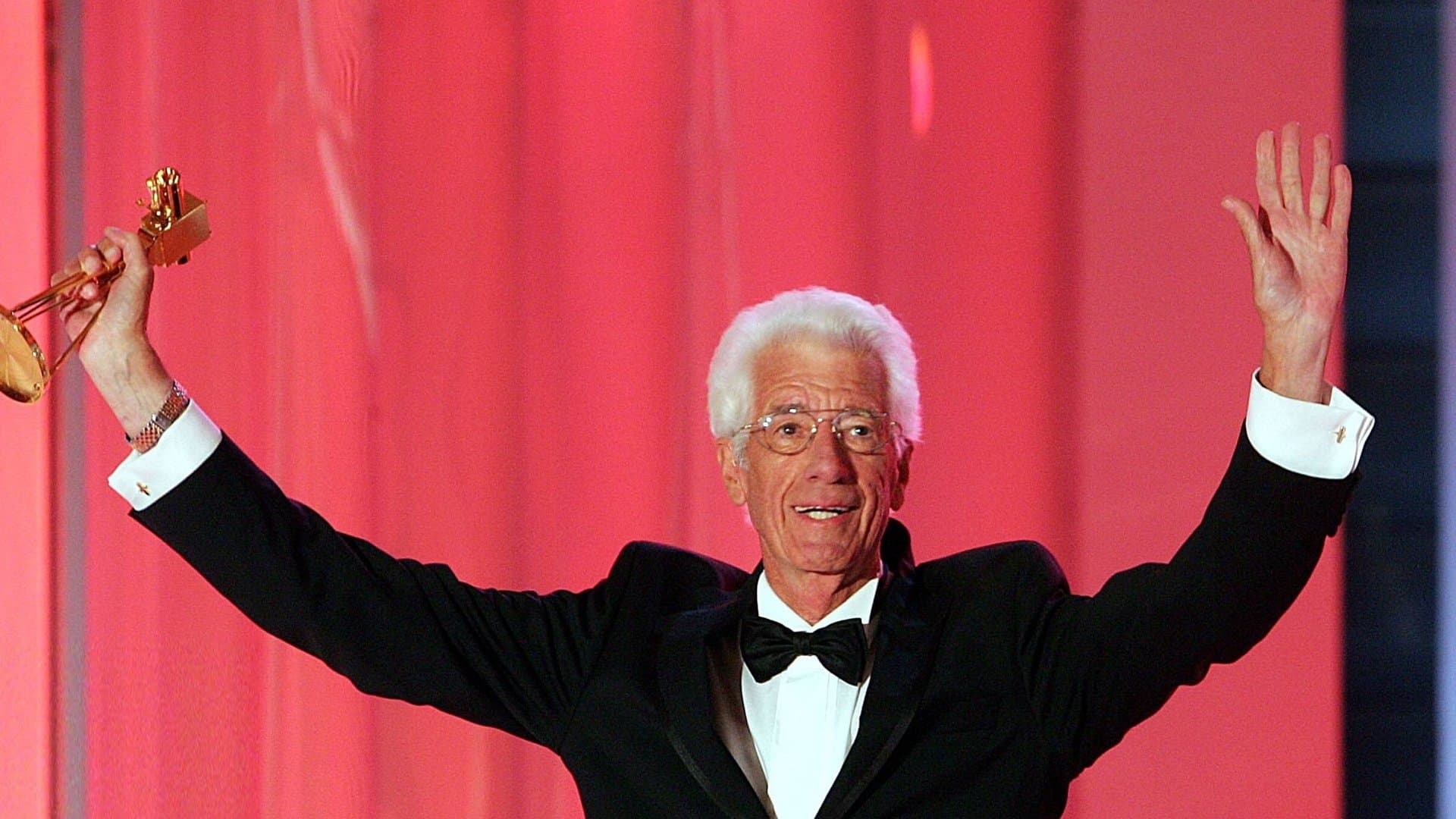
Rudi Carrell (1934-2006) never took the matter of saying goodbye forever too seriously. The legendary show host, who died on July 7, 2006, cracked jokes about death, including (and especially) his own: He was already severely marked by lung cancer when he quipped about the time after his passing: "I will continue to live on for a long time as a rerun."
Rudi Carrell lived to be 71 years old. Of course, after his death he haunted television as a rerun, and the audience realized in rare unanimity: There will never be another one like him.
He followed in his father's footsteps
Rudi Carrell was born in 1934 as Rudolf Wijbrand Kesselaar in Alkmaar, Netherlands. He adopted his stage name from his father André Carrell (1911-1968), a well-known comedian, ventriloquist and master of ceremonies, as hosts of revues, fashion shows and variety shows were called back then. From an early age, Rudi performed on stage with him, showing what would later make him famous: wit, musicality, irreverence and a sure instinct for the audience.
At 17, Carrell left high school without graduating, and he also dropped out of a banking apprenticeship. He wanted to be on stage - and through his father got his start at the public broadcasting station AVRO. Between 1954 and 1964, the young Rudi Carrell became a radio and television star in the Netherlands with his own show. He also wrote songs; with "Wat een geluk!" ("What luck") he represented the Netherlands at the 1960 Eurovision Song Contest in London and came in second to last place. Afterwards, he made fun of himself on his own radio show. His TV program "De Robinson Crusoë Show", on the other hand, received an award at the 1964 Rose of Montreux.
Career start in Germany
In Montreux, he met German TV director Mike Leckebusch (1937-2000) from Radio Bremen. Leckebusch had brought the extremely popular youth music program "Beat-Club" to German television. Leckebusch produced nine episodes of a German "Rudi Carrell Show" with Carrell, which aired between 1965 and 1967.
By this time, two Dutchmen had already made major show business careers in Germany: The first - Johannes Heesters (1903-2011) - moved to Germany as early as 1936 and became a star as an actor and singer during the Nazi era, which he was able to continue in the post-war period. The second was briefly even more popular and was colloquially called "Uncle Lou": The singer and entertainer Lou van Burg (1917-1986) came to the Federal Republic in 1954 and successfully hosted the ZDF show "Der goldene Schuß".
That ended in 1967 because "Mister Wunnebar" had gotten his assistant pregnant, even though he was married to someone else. The morally strict ZDF fired Uncle Lou and desperately searched for a successor. Rudi Carrell was at the top of the list, he too was Dutch, he too spoke that funny "Gouda" German that went over so well with the German audience.
The producer was said to have already reached an agreement with Carrell. The next morning, however, the Dutchman had a feeling that "Der goldene Schuß" would end in disaster for him and "bury" his career. He persuaded the head of his Dutch station to insist on an exclusive contract he had invented, so that a tabloid newspaper formulated the headline: "Dutch television prohibits Carrell from taking over 'Der goldene Schuß'."
Rudi Carrell is a multi-talent
Starting in 1973, he could and would no longer resist the large West German market. He dominated evening entertainment with major shows like "Am laufenden Band", "Rudis Tagesshow", "Herzblatt", "Die Rudi Carrell Show - Laß Dich überraschen" or "7 Tage, 7 Köpfe".
He was everywhere, sang pop songs ("Wann wird's mal wieder richtig Sommer?", "Goethe war gut", "Du bist mein Hauptgewinn"), starred in film comedies like "Wenn die tollen Tanten kommen", "Tante Trude aus Buxtehude", "Rudi, benimm dich!", and did advertising for Edeka.
Behind the scenes, however, the show host was considered extremely demanding. Carrell didn't joke around at work, everything had to be perfect - and in dealing with colleagues he could be hurtful. "This person is inhumane, I've never experienced anything like it", once said cabaret artist Gisela Schlüter (1914-1995). Carrell himself admitted in a 1985 talk show: "I used to be the biggest jerk in Germany. I was disgusting."
His private life was also turbulent. His first wife Truus de Vries, with whom he had daughters Annemieke and Caroline, divorced him in 1973. His second wife Anke Bobbert, mother of his son Alexander, died in 2000. He also lost his partner, screenwriter Susanne Hoffmann: She died of a brain tumor in 2003. Since 2001, Carrell was married to Simone Felischak from Magdeburg, who was 36 years his junior.
Rudi Carrell made his cancer diagnosis public in 2005
In November 2005, Rudi Carrell announced that he had lung cancer and did not have long to live. This announcement was made with the greatest composure. The terrible diagnosis had neither shocked nor surprised him. "I should have had it a long time ago! I always worked five days before a show with virtually no food, after a show only drank beer and smoked at least sixty Lord Extra a day", he said in his last interview in the face of death to "SZ Magazin". He had known "that would go wrong eventually".
In this moving conversation, Carrell also found touching words for his host country: "If I had stayed in Holland, I might have become the director of a television channel. How boring! Germany has given me ten times more than I ever hoped for. I owe this wonderful country my life."
After his death at the Bremen-Ost Hospital, "Spiegel" wrote in its obituary: "Rudi Carrell was an entertainer of the old school with always new ideas. Style, irony, independence gave him an unmistakable profile. He will be sorely missed." Even more enduring in memory is Carrell's judgment about the industry: "In the past they said television makes you stupid. Today stupid people make television."