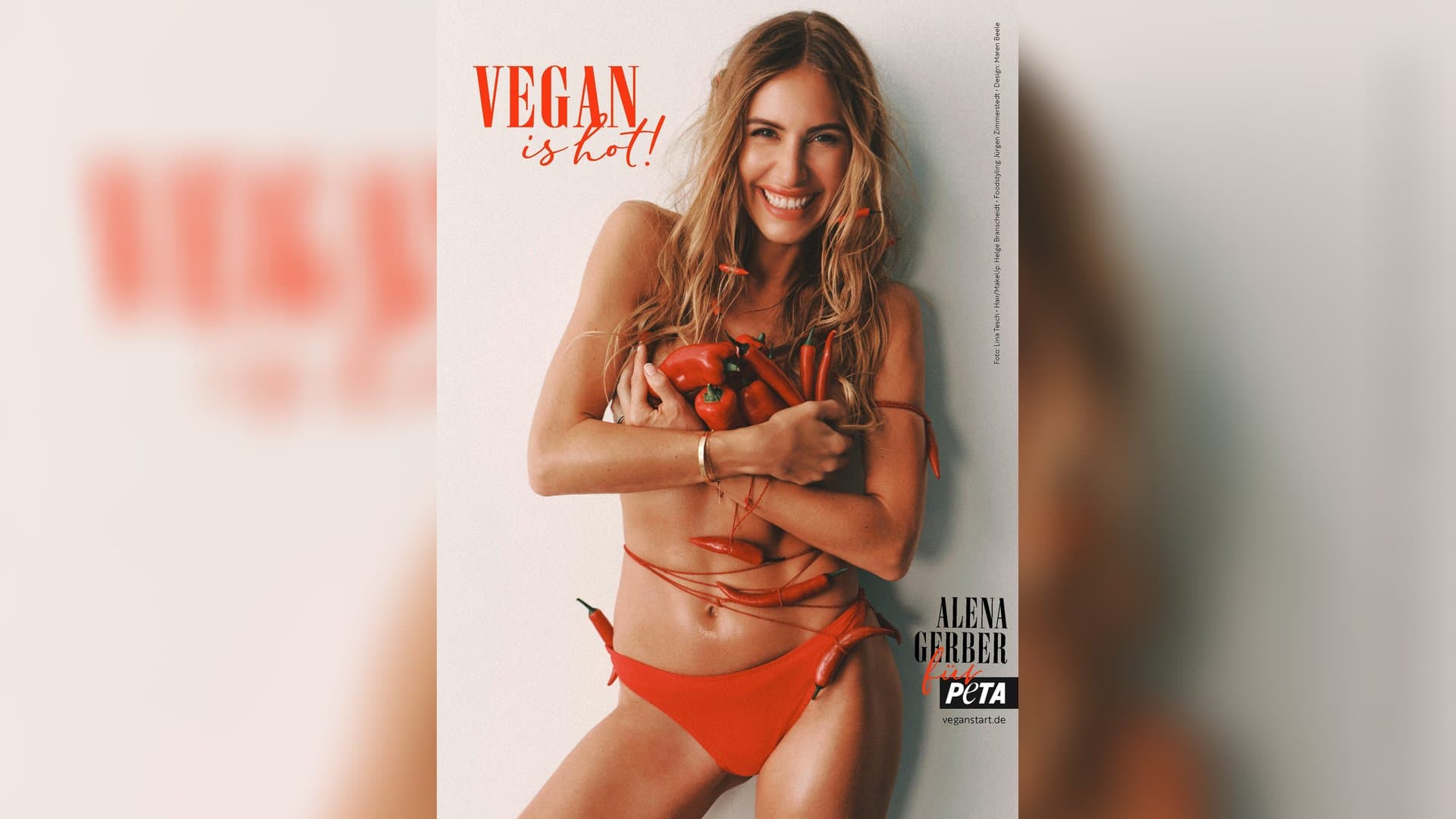
With hot chili peppers and a clear message, Alena Gerber (36) appears in the new PETA campaign "Vegan is hot!". The model has been eating a plant-based diet for more than 20 years and has been committed to animal welfare for many years - not only in front of the camera, but also as a volunteer at animal shelters, at demonstrations, and in the fight against illegal puppy trafficking.
In an interview with news agency spot on news, she talks about the values her late mother passed on to her, her daughter, family dog Onyx, and why she believes that compassion is shown primarily in our decisions.
You're currently posing for PETA and advocating for animal welfare. What was important to you about this campaign?
Alena Gerber: The campaign is called "Vegan is hot" - and that's exactly what we wanted to show: An animal-friendly lifestyle can be modern, enjoyable, delicious, stylish, and natural. We live in a time when there are good plant-based alternatives for absolutely everything. No one has to give up taste, pleasure, or fashion so that animals don't have to suffer.
But it was also important to me that the image generates attention. Animal welfare shouldn't just happen in a small bubble where everyone already agrees. The message should reach people who may have never seriously asked themselves who had to suffer for their food, clothing, or cosmetics. If a striking image causes someone to pause for a moment and reconsider their habits, then it has achieved exactly what I hope for: more attention for my beloved animals.
When did your own relationship with animals start playing a bigger role in your life? Was there a key moment?
Gerber: My love for animals was always there. Even as a baby, I was cuddled up on a blanket with our 175-pound Pyrenean Mountain Dog. My mother literally instilled the love of animals in me from the cradle. I always called our home "Villa Kunterbunt": We had dogs, cats, rabbits, mice, rats, and a horse. Every injured bird, every hedgehog was nursed back to health at our place. There was never a no to an animal that needed help or a home. I'm infinitely grateful to my mother for that - if my husband weren't a bit more firm, it would probably look the same at our place today.
Since my mom died, my commitment has taken on a different depth. It feels like a continuation of what she modeled for me. I believe her greatest wish would be that this love and compassion don't disappear with her, but live on through me and my daughter.
Many know you as a model - but the PETA campaign isn't about beauty, it's about a stance. How was it for you to use your body for this message?
Gerber: I've been working as a model since I was 13 and have used my body for many products, brands, and stories. Over the years, though, I've started saying no more and more often. I even ended two of my biggest advertising deals and gave up a lot of money because the brands partially still worked with fur - even if I wasn't advertising those products.
It's important to me to only lend my face to campaigns that align with my own values. And nothing fits my true self better than animal welfare and PETA.
Of course the image is revealing. But it's not arbitrary. There's a clear message behind it. If my body causes people to look and then talk about animal suffering, nutrition, and their own decisions, then the campaign has already achieved a lot. I don't see our images as provocation for provocation's sake, but as my opportunity to pass on the attention I get through my profession to those who have no voice themselves: animals.
What does animal welfare look like in your everyday life?
Gerber: For me, animal welfare isn't a topic that only happens in public campaigns - I would actually find that totally stupid and hypocritical. In my case, animal welfare determines a large part of my everyday life and my free time. I work as a volunteer for various animal welfare organizations and at the Bremen animal shelter, participate in demonstrations, and regularly accompany and initiate operations as an undercover investigator against illegal puppy trafficking.
Illegal puppy trafficking and so-called breeding animals are my specialties. I've been committed to this for about 20 years now. During this time, I've seen things you never forget. That's precisely why it's important to me to really open people's eyes, create visibility for these issues, and take concrete action. Animals don't need good intentions, but people who actually take responsibility.
What role do animals play in your family life - is there an animal that's almost like a family member to you?
Gerber: Our dog Onyx isn't almost a family member - he is one. My daughter even calls him "her brother". The two of them grew up together, share their daily lives, and have a beautiful connection.
My daughter also regularly helps me at the animal shelter, cleans stalls there, and takes care of injured animals. It's important to me to teach her from an early age to take responsibility for other living beings. And she does that really wonderfully. She's just as crazy about animals as I am.
What would you say to people who love animals but don't see a need for change when it comes to food, clothing, or consumption?
Gerber: I immediately believe many people when they say they love animals. But in the end, love isn't just shown in a feeling, but also in our decisions. We can't say on one hand that animals touch us, and on the other hand completely ignore what happens to them for our food, our clothing, or our cosmetics.
I'm not saying this to morally put anyone down. We all grew up with certain habits. But today we have knowledge and alternatives that previous generations didn't have. There's plant-based milk, yogurt, cheese, meat alternatives, plant-based shoes, innovative materials, and excellent cruelty-free cosmetics. No one has to be perfect overnight. But changing nothing at all, even though you know animals are suffering, isn't a convincing position for me.
I wish people wouldn't immediately go on the defensive, but would simply try it out: drink coffee with almond milk, order the plant-based dish, or buy cosmetics without animal testing. Every small change can make a big difference.
Is there an animal welfare issue where you feel society still looks away far too much?
Gerber: Yes! I'm particularly shocked by how much animal suffering is made invisible in our society. Most people would never hurt an animal themselves. But as soon as the suffering happens behind closed barn doors, in a laboratory, on an animal transport, or in a supply chain, it's simply ignored.
An issue where far too little attention is paid is, in my opinion, the trade in baby animals over the internet. Animals that are far too young, sick, or bred under terrible conditions are offered there like toys. People see a cute photo and don't question what suffering lies behind this supposed bargain. Animals aren't commodities that you order spontaneously. Anyone who takes in an animal assumes responsibility for a sentient being.
And even with so-called farm animals, many still lack an emotional connection. A dog is considered a family member, while a pig, which is at least as intelligent and sensitive, is only viewed as a product. Why is that still the case? That hurts me indescribably.
What is a quality of animals that we humans could learn from?
Gerber: Their unconditional honesty. Animals never pretend, they don't play roles, and they don't calculate their affection. When an animal trusts, it trusts with its whole being. And when it's afraid or suffering, it can't hide that behind polite words.
I believe we humans could learn from animals to feel much more directly and honestly again. They live much more in the moment, don't carry grudges around, and don't judge their counterparts by status, appearance, or success. For an animal, what counts is how you treat it and whether your heart is kind. I think that's a very wise standard - for us humans too.